
For local authorities across the UK, the 2026 budget cycle is underway with familiar pressure and intensity. UK Council Leaders are being asked to protect services, improve outcomes, meet legislation and deliver savings, all at the same time. Increasing demand, alongside inflation, means a several percent cost saving requires at least a ten percent increase in productivity to avoid slashing service quality/frequency.
One message is becoming increasingly clear: the strongest lever for financial sustainability now lies in how well councils optimise their frontline and corporate services.
The Value of Keeping Services Close
Many councils are exploring alternative service models like outsourcing and establishing shared services. The former tends to come with paying a supplier’s margin and the latter takes substantial time and investment. To meet short-term pressures, and set up for long-term success, the councils achieving the best outcomes for residents are those who are investing in strengthening their in-house capabilities: boosting productivity, simplifying processes, and ensuring frontline teams have the structure and support to deliver consistently.
A recent example comes from Warrington Borough Council, who wanted to retain their school meals service in-house but needed to make it financially sustainable. By working with frontline teams and managers, we helped introduce clearer controls, scientific resource planning and upskilled management to deliver the service more optimally. This shift reduced ingredient spend without reducing quantities, delivered a 10% increase in meals per hour, a 23% reduction in overtime and £340k in annualised benefit during the lifetime of the project. Crucially, it strengthened the council’s ability to run a vital local service themselves, protecting jobs and ensuring over 6,000 pupils continued receiving reliable, good-quality meals, many of whom depend on the free school meals service.
The project demonstrated that when services are run optimally, they are economical to retain in-house, leaving the service resilient.
Steven Broomhead, former CEO of Warrington Borough Council commented:
“Managementors provided cost effective insightful advice and best practice to deliver a much needed transformation of the school meals service. They were sensitive to service and staff issues and the project was delivered to budget and time. I recommend Managementors to other Local Authorities.”
Budgeting for 2026: A Shift in Mindset
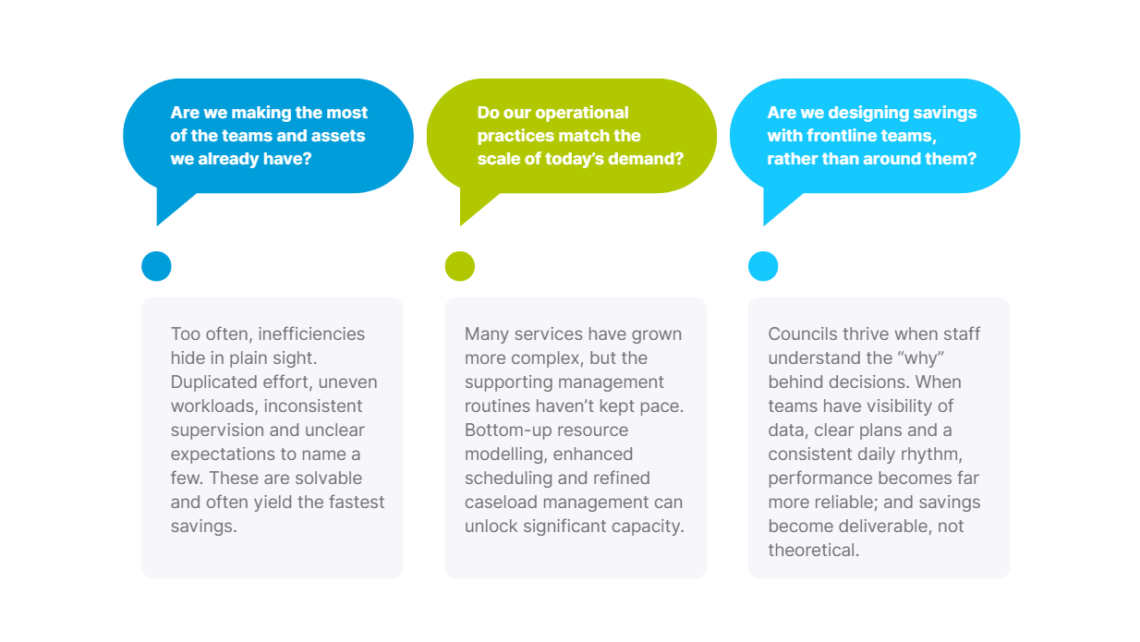
As councils review their medium-term financial plans, the discussion must move beyond headline savings targets. Instead, leaders should challenge their organisations with three questions:
Balancing Cost Control and Outcomes
The misconception that productivity improvements come at the expense of resident outcomes is long outdated. In reality, they move together.
- When teams are structured well, residents get quicker responses.
- When processes are simplified, cases are resolved first time, and faster, more often.
- When managers have clear daily controls, cost becomes predictable and last-minute surprises reduce.
The most effective local authorities are those who view operational improvement as a strategic capability. They view productivity as something that protects budgets and resident service.
A More Confident Future for Local Authorities
As budget reviews intensify over the coming months, council leaders have an opportunity to shift the narrative. Rather than focusing solely on cuts, there is real value in asking: how do we help our in-house services to perform at their absolute best?
If services run well, and productivity rises, council leaders are able to meet their savings goals whilst preserving quality. By investing in services and implementing the best practice for 2026, council leaders can make choices grounded in long-term stability rather than short-term necessity.
As we’ve seen in our work across local authorities, the gains are both measurable and sustainable, often cash flow positive within six months and demonstrating significant social value.