
Large programmes rarely fail because the strategy is wrong. They fail because the strategy never becomes something people can execute. When high‑level plans aren’t broken down into monthly, weekly and daily actions, teams are left guessing, issues surface too late and delivery becomes unpredictable.
So why does the translation from strategy to daily activity so often break down, and what needs to change to ensure plans are delivered?
Why High-Level Plans Fail to Translate into Action
- High-level plans lack operational clarity
High‑level plans set the direction, but they often stop short of explaining what needs to be done and by when. Objectives are broad and open to interpretation, which creates uncertainty around priorities and ownership. Without defining what needs to be done, by whom and by when, delivery becomes inconsistent and progress slows.
- Lack of short interval control (SIC)
Short‑Interval Control (SIC) means reviewing progress in short, frequent cycles. When progress is only reviewed monthly or quarterly, issues surface too late. Without SIC, teams lose visibility of how work is progressing. Small problems build unnoticed, and by the time they are raised, they are harder and more expensive to fix.
- KPIs and metrics are not aligned to delivery
Measures tend to focus on overall outcomes rather than progress against the plan. When metrics are disconnected from day‑to‑day delivery, they fail to highlight emerging risks, with reporting becoming the priority rather than managing performance in real time. Many programmes measure outcomes, not the work required to achieve them, which means early warning signs are missed.
- Delivery is not actively managed
Plans exist, but they are not driven through delivery. Without active management, issues are discussed but not resolved, decisions are delayed and actions drift. Clear ownership, timely decisions and rapid issue resolution are essential to prevent priorities from blurring.
- Tasks are not defined at a daily level
Work is often planned at too high a level, leaving teams unclear about what needs to be achieved daily. Without clear task definitions by activity or team, effort becomes fragmented, coordination suffers and progress slows. Daily task clarity ensures teams know what “good” looks like each day and prevents momentum from stalling.
These challenges arise because high‑level plans are often treated as static documents rather than working delivery tools. Without active management, short‑interval control, aligned metrics and defined daily tasks, delivery is left to interpretation. Plans become reference points rather than live management tools, making it difficult to see issues early, intervene decisively and maintain momentum. To turn ambition into results, organisations must break strategy down into work that can be planned, measured and controlled daily. that wrong, and you’re not simplifying your business, you’re just scaling the problem.
How to Break Down High-Level Goals into Actionable Steps
Start with the outcome, then work backwards
Every plan should begin with a clear definition of the intended outcome. Defining the outcome first and mapping the steps backwards creates a direct line of sight from strategy to delivery and removes ambiguity around priorities.
Translate strategy into monthly, weekly and daily commitments
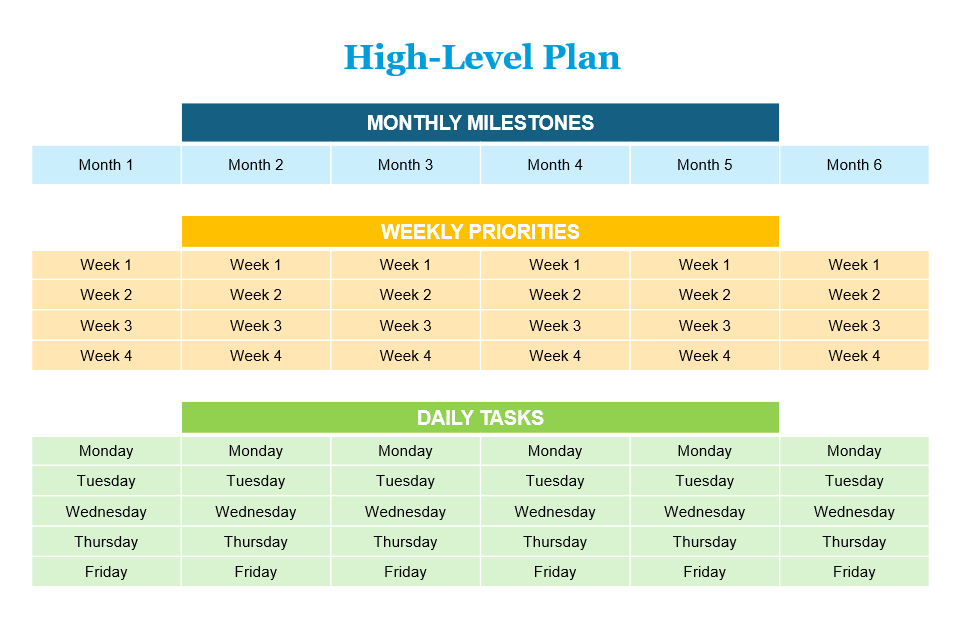
High-level strategy should be converted into clear, outcome-focused milestones, supported by weekly priorities and specific daily plans by team, underpinned by clear Standard Times to define the time expected to complete a task, creating a common planning standard across teams. This creates a direct link from strategic intent to day-to-day delivery, making priorities explicit, strengthening ownership and enabling more reliable planning and control.
Manage performance in real time
Plans only deliver value when performance is actively managed. Metrics, including Utilisation, Effectiveness and Productivity give teams visibility and enables management by numbers. Combined with short-interval reviews and clear ownership, this allows issues to be addressed early and delivery to stay on track.
Applied consistently, these practices will assist the transition of high-level plans into daily activities. Defining the outcome and working backwards removes ambiguity around priorities and success. Converting strategy into monthly, weekly and daily commitments provides the operational clarity that is often missing and supports short-interval control. Managing performance in real time, through clear metrics and managing by numbers, ensures delivery is actively driven rather than passively reported.
Turning strategy into action depends on how delivery is managed day to day. When outcomes are clear, work is broken down and progress is managed regularly using metrics, teams gain the clarity and control that high‑level plans often lack. This builds confidence, reduces risk and significantly increases the likelihood of delivering what was promised.